
UK online casino rules in 2026: what matters when checking Luckster
 Available in GB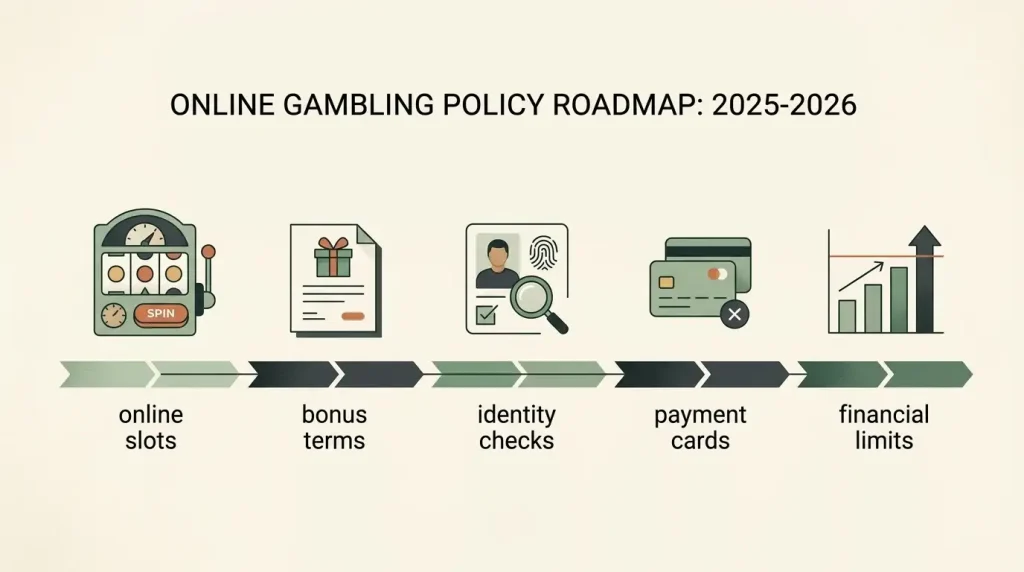
Several Great Britain rules now make old casino reviews materially misleading if they are read without dates. In 2026, UKGC-licensed operators face a 10x cap on bonus-fund wagering requirements and cannot combine multiple gambling product types in one incentive. Online slots have maximum stakes of £5 per game cycle for players aged 25 or over and £2 for players aged 18 to 24. Credit-card funded gambling is prohibited, remote customers must have their identity verified before gambling, new customers must be prompted to consider a financial limit before the first deposit, and light-touch financial vulnerability checks use a £150 net-deposit threshold over a rolling 30 days.
These are Great Britain rules, covering England, Scotland and Wales. Northern Ireland has a different gambling-law framework and should not be described as if the Gambling Commission regulates gambling there in exactly the same way. For Luckster, the rules are context for judging stale claims, not evidence that the currently inactive luckster.com domain is compliant or open.
Table of Contents
- Rules that change how an old Luckster review should be read
- 2025 and 2026 Great Britain online casino rule timeline
- The 10x wagering cap changes how old Luckster promotions should be interpreted
- Online slot stakes are capped at £5 or £2 depending on age
- Credit cards remain prohibited for online casino gambling
- Identity verification comes before gambling, not just before withdrawal
- £150 vulnerability checks and pre-deposit limit prompts are different controls
- Great Britain is not the same regulatory territory as the whole United Kingdom
- Ordinary player gambling winnings are generally outside Income Tax
- How to test a current-looking Luckster claim against the 2026 rulebook
- Which 2026 Great Britain rules matter most when checking a casino like Luckster
Rules that change how an old Luckster review should be read
Luckster reviews written before 2025 or early 2026 can preserve bonus terms, slot descriptions and account flows that pre-date major regulatory changes. A historical detail may have been accurate when written yet still be unusable as current guidance.
The best way to read an older review is to separate brand history from the current market baseline. Our full Luckster review uses that method throughout: historical Luckster facts are kept as history, while current Great Britain rules are checked against regulator and government sources.
The brand-specific status still comes first. The current Gambling Commission register lists www.luckster.com as inactive, so the rules below should not be read as proof that Luckster currently accepts registrations. See is Luckster still open for that separate question.
2025 and 2026 Great Britain online casino rule timeline
| Date | Rule | Current meaning | Why it matters for Luckster history |
|---|---|---|---|
| 28 February 2025 | Financial vulnerability threshold | Specified light-touch checks apply when deposits minus withdrawals exceed £150 in a rolling 30-day period, subject to the LCCP details and prior-check exception. | Old account guides will not necessarily reflect the current public-record check framework. |
| 9 April 2025 | £5 online slot stake limit | The £5 per-game-cycle maximum took effect for adults aged 25 and over. | Older descriptions of slot stake ranges can be stale even if the same game title still exists elsewhere. |
| 21 May 2025 | £2 online slot stake limit | The lower £2 maximum applies to adults aged 18 to 24. | Age now directly changes the maximum stake allowed on online slots. |
| 31 October 2025 | Financial-limit prompt | New customers must be prompted to set a financial limit before their first deposit and must be able to review or alter it. | Historical sign-up journeys are not a reliable picture of a current regulated onboarding flow. |
| 19 January 2026 | Bonus rules | Wagering requirements on bonus funds cannot exceed 10x and an incentive cannot combine more than one gambling product type. | Old Luckster casino-and-sports promotions may no longer match the structure now permitted under the LCCP. |
| 30 September 2026 | Gross deposit-limit definition | Scheduled change: operators must offer gross deposit limits and only that form of limit can be called a “deposit limit”. | This change is scheduled for 30 September 2026, so any later assessment should use the standards in force after implementation. |
The 10x wagering cap changes how old Luckster promotions should be interpreted
From 19 January 2026, the Gambling Commission’s rewards and bonuses rules cap wagering requirements at 10 times the bonus funds. The same rule set prevents an incentive from including more than one gambling product type, such as combining casino and betting activity in one promotion.
That means a historic Luckster welcome package should not be treated as current merely because an old review still displays a deposit match, free spins or sportsbook element. The relevant question is not whether that promotion once existed. It is whether a currently active, licensed operator is offering a promotion that fits the current rules and publishes current terms.
Our Luckster bonus status page therefore keeps old Luckster offer material in historical context rather than recommending a current claim. The primary rule wording is available from the Gambling Commission’s published rewards and bonuses rule.
Online slot stakes are capped at £5 or £2 depending on age
The Great Britain online-slot rule is product-specific. Players aged 25 or over cannot stake more than £5 per game cycle on an online slot. Players aged 18 to 24 are limited to £2. The Gambling Commission also makes clear that these slot limits do not apply to other casino games such as roulette or blackjack.
This distinction matters for an older Luckster games page. A historic slot catalogue may still be useful for understanding what providers or titles were once present, but any old statement about how much could be staked must now be read against the current slot limit. Our game coverage therefore separates the historical library from current Great Britain rules rather than pretending the old lobby is live.
The official current guidance is the Commission’s online slots stake limit guidance.
Credit cards remain prohibited for online casino gambling
UK-licensed online casinos cannot accept credit-card funded gambling payments. The prohibition also reaches e-wallet routes where the wallet allows a customer to load funds from a credit card and then use those funds for gambling. The Commission expects operators accepting e-wallets to ensure that the relevant wallet does not permit that route.
That makes old payment-method lists particularly easy to misread. A historical Luckster cashier could have displayed methods or descriptions that no longer fit the current regulatory position. Our Luckster payment methods page therefore separates historical brand banking from the live Great Britain payment rule.
The regulator’s current explanation is set out in its credit-card use guidance.
Identity verification comes before gambling, not just before withdrawal
Remote licensees must establish customer identity before the customer is permitted to gamble. The minimum information listed by the Commission includes name, address and date of birth. The same rule says that a withdrawal request should not result in additional information being demanded if the operator could reasonably have asked for it earlier.
This is a regulatory baseline, not a universal document list. A passport, driving licence, bank statement or source-of-funds request can depend on the operator and circumstances. For Luckster, no current official account page supports a present-day KYC checklist, so the Luckster account and KYC guide keeps that distinction explicit.
£150 vulnerability checks and pre-deposit limit prompts are different controls
Two current measures are often blurred together. First, the financial vulnerability check condition uses a threshold where deposits minus withdrawals exceed £150 in a rolling 30-day period. The minimum check looks at public-record indicators of significant financial vulnerability, including specified insolvency and court-record signals. A previous qualifying check within the prior 12 months can affect whether another check is required at the threshold.
Second, since 31 October 2025, operators must prompt new customers to set a financial limit before the first deposit and make it easy to review or alter that limit later. This is not the same thing as saying every customer is forced to choose a mandatory deposit cap. It is a customer-led control with a required prompt and supporting tools.
A further technical change is scheduled for 30 September 2026. From that date, operators must offer gross deposit limits, and only the gross form may be labelled a “deposit limit”. That implementation date was extended from June 2026. The change takes effect on 30 September 2026, after which the live standards should be used for any current assessment.
Great Britain is not the same regulatory territory as the whole United Kingdom
The Gambling Commission’s jurisdiction under the Gambling Act 2005 covers Great Britain: England, Scotland and Wales. Northern Ireland has a separate gambling-law framework. The Commission does have specific roles affecting remote operators and advertising into Northern Ireland, but it does not regulate gambling activity there in the same way as it regulates Great Britain.
That is why this guide uses “Great Britain” when describing UKGC casino rules. Saying that every rule applies identically across the UK would be too broad. The Commission’s current Northern Ireland remit page sets out the distinction directly.
Ordinary player gambling winnings are generally outside Income Tax
HMRC’s current business-income guidance states that betting and gambling, as such, do not constitute trading and that the ordinary punter is not normally carrying on a trade. In practical terms, ordinary gambling winnings for a player are generally not subject to UK Income Tax, while losses do not create tax relief.
This is intentionally narrow. It is not personal tax advice and it should not be stretched to unusual business structures or professional activities. It is included because old casino pages sometimes confuse operator taxes, levies and duties with taxes paid by ordinary players. HMRC’s current position can be checked in BIM22015.
How to test a current-looking Luckster claim against the 2026 rulebook
- Check status first. Confirm the exact domain in the regulator register before treating any bonus, cashier or registration page as actionable.
- Date the promotion. A current Great Britain incentive should fit the 10x wagering cap and single-product structure introduced in January 2026.
- Separate slot rules from other casino games. The £5 and £2 caps apply to online slots, not roulette or blackjack.
- Reject credit-card funded casino deposits. A current licensed cashier should not offer a route that breaches the credit-card prohibition.
- Expect identity checks before gambling. Do not interpret late-stage KYC friction as the normal planned account model when the regulator expects identity to be established earlier.
- Look for financial-control prompts. A modern account journey should reflect current limit-setting requirements, with gross deposit-limit terminology changing again from 30 September 2026.
These checks are useful even when the casino name is familiar. The licence and trust checks page explains the Luckster-specific operator record, while this page supplies the market rules needed to interpret it.
Which 2026 Great Britain rules matter most when checking a casino like Luckster
The most useful rules are the ones that expose stale information quickly: domain status, identity verification before gambling, the 10x bonus wagering cap, age-based online-slot stake limits, the credit-card ban and the newer financial-control requirements. They do not prove that Luckster is active – the current luckster.com entry is still inactive – but they show what a genuinely current Great Britain-facing casino page should reflect. Any Luckster relaunch would need to be judged against the rulebook in force on that future date, not against the terms preserved in an old review.